
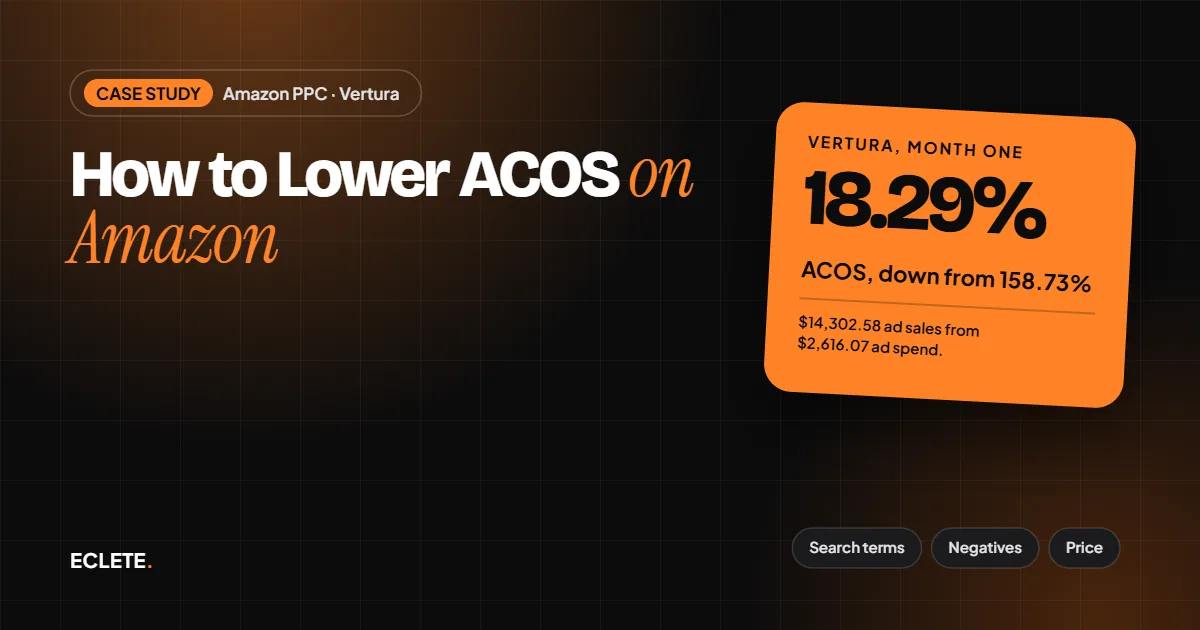
ACOS is your ad spend divided by your ad sales. To lower it, stop paying for clicks that don’t convert, put more budget behind the searches that do, and fix anything on the listing or price that stops shoppers buying. That is how we took a new batting cage for Vertura from 158.73% ACOS in launch week to 18.29% one month later, with real Amazon Ads screenshots below.
Vertura sells on Amazon US, so its figures are in dollars. The same steps work on Amazon UK.
What ACOS means, and what a good ACOS is
ACOS (advertising cost of sales) = ad spend ÷ ad sales × 100. If you spend £20 on ads and they bring £100 in sales, your ACOS is 20%.
A “good” ACOS depends on your profit margin. Your break-even ACOS is your margin before ad costs: if you keep 30% of the price after Amazon fees and product cost, a 30% ACOS means ads make no profit and no loss.
| Margin before ads | Break-even ACOS | Profitable ACOS |
|---|---|---|
| 20% | 20% | Below 20% |
| 30% | 30% | Below 30% |
| 40% | 40% | Below 40% |
ACOS and ROAS are two ways of saying the same thing: ROAS = 1 ÷ ACOS. A 25% ACOS is a ROAS of 4.
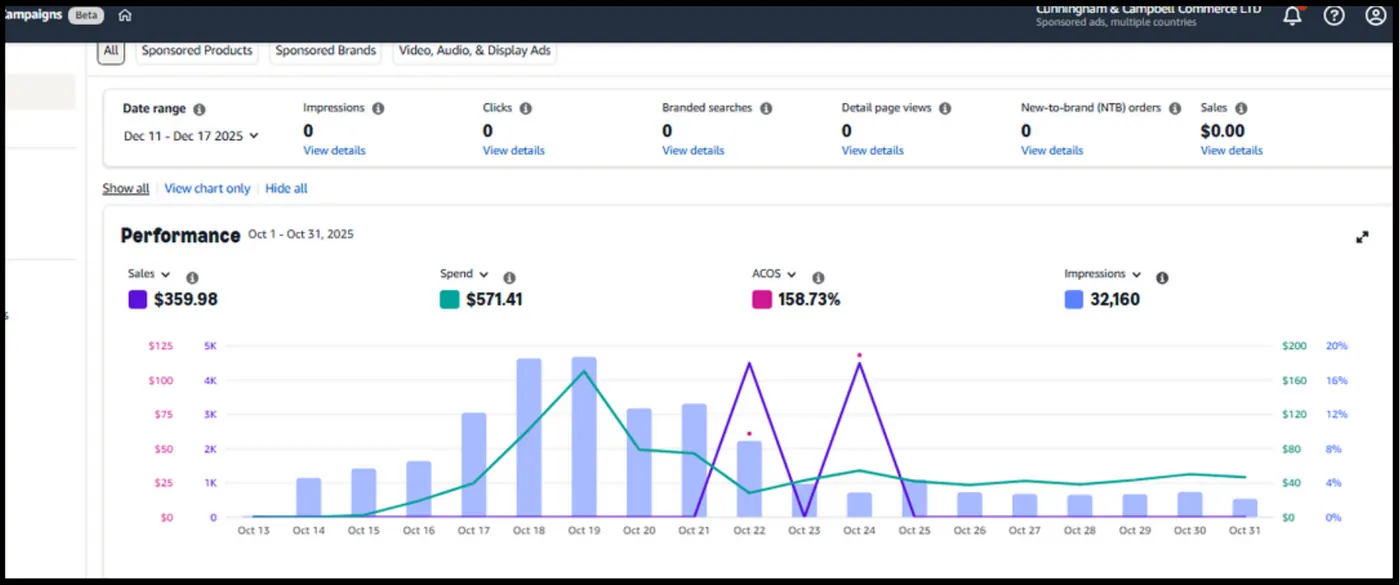
The starting point: 158.73% ACOS in launch week
Vertura came to us with one product: a baseball and softball batting cage, with zero reviews, a launch price above the market, and big brands all around it. In launch week, every $1 of ad sales cost about $1.59 in ads.
Three things drove that number:
- No reviews, so shoppers who clicked were less likely to buy;
- a high price next to established products;
- broad targeting, which bought traffic that was close to the product but didn’t convert.
What we changed over four weeks
1. Read the search term report every week
We looked at every search that had spent money. Most of the waste came from terms that were related but wrong for a full-size batting cage. If your ads get clicks but no sales, our 9-point checklist covers this step in detail.
2. Paused weak keywords and added negatives
Keywords with clicks and no orders were paused, and irrelevant searches were added as negatives, so the budget stopped leaking.
3. Scaled the winners
Searches that did convert got more budget, and spend moved to the keywords and placements that sold.
4. Adjusted the price after week one
The launch price was above the market. We adjusted it after the first week to speed up conversions, and later matched it to the category leaders to finish the stock.
5. Made the listing convert
A keyword-rich title, bullets and backend terms, plus images and A+ content that show size, set-up, what is in the box and indoor or outdoor use. Ads only work as well as the page they send shoppers to.
The result: 18.29% ACOS one month later
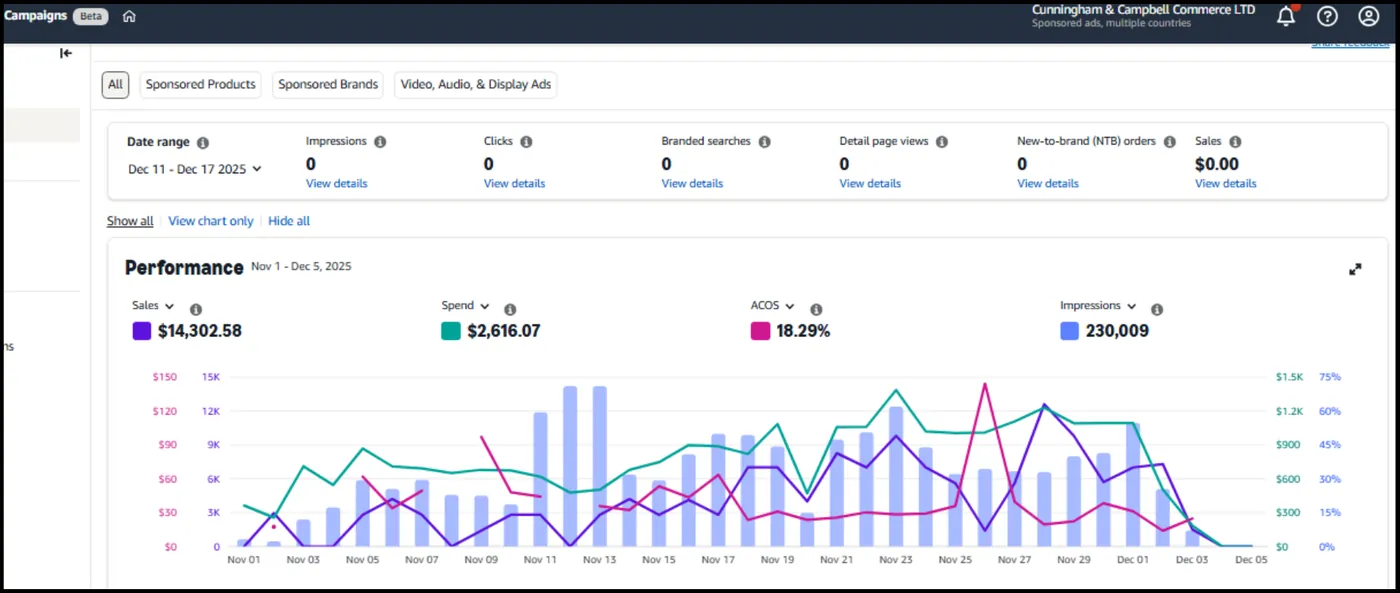
Within two weeks Vertura became the #1 New Release in Baseball & Softball Batting Cages, and in month one the listing passed 200 sales a month. All 253 units of the first batch sold out in under 50 days.
Why lower ACOS also lifted organic sales
Good ads build sales history, and sales history lifts organic rank. Between 16 October and 28 November 2025, Vertura moved to the top of page one for its main buyer searches, and five buyer keywords reached the top three.
| Search on Amazon US | 16 Oct 2025 | 28 Nov 2025 |
|---|---|---|
| batting cage for backyard | #57 (page 2) | #1 |
| softball pitching machine net | #31 | #1 |
| batting cage with pitching machine hole | #17 | #2 |
| pitching machine cage | #36 | #3 |
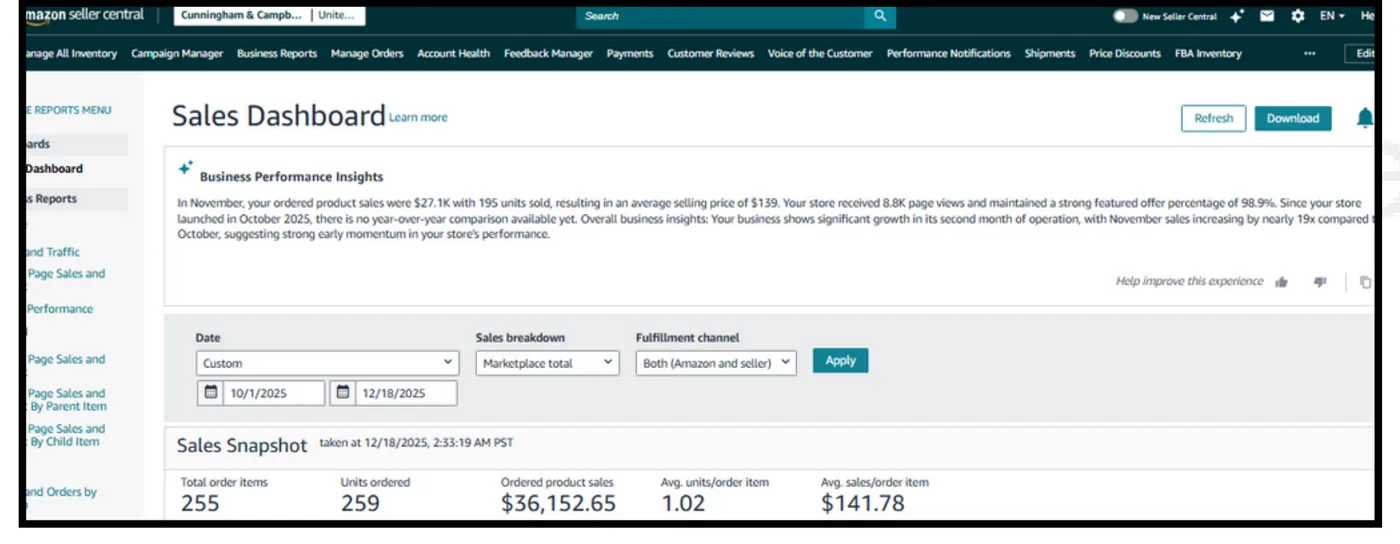
That is why 59% of the first batch’s $35,681.08 in sales came without ads: $14,662.56 came from ads and the rest was organic. The full first batch made $2,398.47 net profit after every cost.
See the full Vertura case study for the timeline and the profit and loss.
7 ways to lower ACOS on your own account
- Work out your break-even ACOS so you know what “too high” means for you.
- Review search terms every week and add negatives for searches that won’t convert.
- Move proven searches to exact match and give them their own budget.
- Cut bids on product-page placements if top-of-search converts better.
- Check your price against the products shown next to yours.
- Improve the listing: main image, title and bullets decide whether a click becomes a sale.
- Don’t judge too early. Give keywords enough clicks before pausing them.
This is the weekly work our Amazon PPC management team does on every account.
When a higher ACOS is fine
During a launch, or when you are pushing a product up the rankings, a high ACOS for a short time can be the right choice: ad sales help organic ranking, and organic sales cost nothing in ads. Plan how long, and at what cost, before you start. Our Amazon agency UK team plans launches this way.
More results from accounts we manage:
What clients say about working with ECLETE
Real video reviews from our clients. Tap any video to watch it with sound.
Read all 50+ client reviews →Frequently asked questions
What is a good ACOS on Amazon?
One below your break-even ACOS, which is your profit margin before ad costs. For many products this is somewhere between 15% and 35%, but it depends on your margin.
Should ACOS be high or low?
Lower means each ad sale costs less. A higher ACOS can be acceptable for a short time during a launch, when ad sales help organic ranking.
What ROAS is a 25% ACOS?
A ROAS of 4: every £1 spent on ads brings £4 in ad sales.
How long does it take to lower ACOS?
Wasted spend can usually be cut within a few weeks. In Vertura’s case, ACOS went from 158.73% to 18.29% in one month.
Does lowering bids always lower ACOS?
Not always. Lower bids can also cut your best-converting traffic. Remove bad searches first, then adjust bids.

Fakher Rasheed is the founder of ECLETE, a UK-registered Amazon and ecommerce growth agency. With over 7 years of experience, he has helped brands go from zero to scale across 20+ marketplaces, covering everything from launch and listings to Amazon PPC management. His work includes building RIPTIC from scratch to more than $1M in sales within 18 months.
